Author’s blog
GRIEF AND GRATITUDE
Today marks 15 years since Derek Youngs, my beloved husband, mentor, playmate, and co-author of “Walking to Japan” died. I am not sad today. I am grateful, and I am grieving.
I don’t say this because I want pity, or sympathy, or because I am dredging up the past or wallowing, or need help. I want to share this because I think my experience and wisdom is worth sharing.
Grief is not a simple emotion like sadness. Maybe it’s not even an emotion at all. It is the painful absence of someone or something that had an important place in your life and likely gave you joy— something or somebody you loved. And, joy being more nuanced and complex than happiness, so is grief more nuanced and complex than sadness. It has also been said that you’ll only ever have a superficial understanding of one without experience of the other. Grief is never so deep without having experienced the heights of joy. (The highest heights of joy coming from love.) And joy is never so all-encompassing as when contrasted against the depths of grief.
Grief is not something you recover from. Is joy something to recover from? These are two major aspects of human experience, part of the rich tapestry of life. They co-mingle, overlap, give way to each other, and potentiate each other’s full expression.
Grief has been described as a wave, but I think perhaps all emotions are like this. They come and go. Even today, grief is coming and going in tiny waves. But in 2011, the waves were bigger and longer. And sometimes they knocked me down. However, in the weeks and months after Derek died, I felt wrapped in a bubble of love — The Circle, we called it. This holy matrix was something we created together, over the short span of years we knew each other., simply by being together. A very concentrated matrix it was, as we were seldom apart, at least after we became a couple. The energy of deep play, honesty, curiosity, passion and dedication to peace were all ingredients of the Circle. And the Circle kept me safe.
This bubble of love didn’t prevent grief, though. Grief was already part of the bubble. Four years before Derek’s death, we shared the profound experience of caring for Lin, his beloved wife of 15 years, while she went through the journey of dying from cancer. It is hard to explain how formative this experience was for me, but I have written about it. I felt my own grief losing her as a friend, but I also felt Derek’s grief. Certainly not to the depth and breadth he did, of course, but both empathically and through observation I did experience it.
This might sound strange, but I loved how Derek so easily expressed his grief. It could come on quickly, triggered by a memory, or by seeing or hearing something Lin had loved or said or done. He would break easily into sobbing, and often I would begin crying with him. But then, just as easily, after allowing the emotion full expression, he would be present with whatever else was happening, internally or externally. He laughed as easily as he cried. And it seems I share this trait. I like this about myself.
I was the first in my circle of friends to lose my parents. My mother died when I was 23. I was not a child, and of course some children lose parents. (Each of parents respectively, at the age of 16, lost their fathers.) But, I was still quite young in many ways and I knew no one who’d yet lost their folks. I had no context for this, and neither did my friends. They expressed condolences, and then nothing else was said. I was disappointed, I think, to not be swept up by my group of friends and rallied around, with caring words and actions. But I didn’t really have a group. Some older folks were helpful as I began to navigate uncharted territory. I felt their love and support. But my peers, not so much. I wish they’d expressed concern or curiosity, and invited me to express my anything at all. But they probably needed to be cued to to do this, and I didn’t know how to. It’s clunky. We don’t learn these things anymore.
I ended up moving away from my hometown not long after my mother’s death, into a new community. Somehow this protected me all the awkwardness and disappointment I’d felt. My partner at the time nurtured me readily, and his family loved me too, so, in a sense, I didn’t fully experience the absence of my mother until this partnership ended three years later. At that point I felt very alone. I couldn’t explain to others that not only was I grieving the loss of a lover, I was grieving my mother. My grief was catatonic at times, but it shifted, as it does, and became part of the rich fabric of my life.
Since then, I have lost my father, beloved friends, dear relatives, and a husband. I have experienced other kinds of losses too — most recently another partnership and the dream and home attached to that partnership. The grief of this is no longer so sharp. Making sense of the whole experience is still something I grapple with, but I know that, once again, the grief has become part of the fabric of my life. It is not something to fix. Generally, I think I feel no need to explain or expunge grief; I just feel it. But, when I am with others, grief can become difficult. Sometimes, if I bring it up, I get the impression that friends want me to move on already.
We generally, as a culture, seem to need to explain emotions, diagnose them, and fix them if they are “negative”. We pathologize grief; loss is something we’re not supposed to focus on. Anything more than x number of weeks or months or years, then we are “dwelling” on our loss. We haven’t processed properly. I call bullshit. Do we ever lose sight of the miracle and joy of birth, of witnessing someone coming into this world? Why should we get over loss? Why not honour it, continually?
Of course there is a time and place to go delve into deep conversation, but I guess sometimes it’s hard for me to discern the right time. I can easily sense when others are uncomfortable, and this makes me uncomfortable. I see people deflect, try to change the mood, change topics. And so, I pull back. And before you say anything, reader, I do realize that it’s not my job to make people comfortable. I am working on this. But it’s effing hard. Articulating my emotions, my needs, my desires, in words, in the moment, is not something that comes as easily to me as the expression of those emotions. I am still learning.
In the weeks and months after Derek’s death, I quickly discovered I needed time on my own. I will never forget the shock of a (casual) friend asking me when I bumped into her on the street just a couple of months after Derek’s passing, “So what are you up to?” I was dumbstruck, confused, and enraged. What am I up to? What the hell did she think I was up to? I was grieving a momentous loss, and there was nothing more important to me at the time. I can’t remember what I managed to say, but I am sure I did not express my anger.
I will also never forget the sting of another, closer, friend’s reaction when I shared some painful feelings with him. With a laugh and a big smile he quipped, “But Derek’s still with you!” Again, I was dumbstruck. Although I believed it to be true, that Derek was still with me in some form, there is a world of difference between experiencing someone’s love and companionship and humour in physical reality and in the spiritual dimension. My new-agey friend clearly had not yet lost anyone dear to him, I later realized. And/or, he was spiritually bypassing. To him, his clear-cut truth with a capital “T” apparently trumped the very real, deep, physical experience of grief. To me, they were both true.
Once again, although I am sure my friend s had the best of intentions, neither of them knew how to deal with me in my grief because I didn’t, or couldn’t, tell them. I couldn’t yet articulate that I didn’t want anyone distracting me from my feelings, I didn’t need cheering up, didn’t need to not be lonely. What I wanted was to be acknowledged in my grief, and allowed to feel the loss, feel the shakiness, and recalibrate, in my own time, how I would live my life.
My initial anger, shock, resentment, and disappointment turned into a resolution to do grief MY WAY. I knew I would inevitably return to the stream of ordinary life in my own time, but while I could, I wanted to submerge myself in the richness of grief, and the Circle which held me safely in its embrace. Even though I couldn’t necessarily explain any of this at the time, I feel so glad I listened to myself, and so fortunate to have a lot of friends who trusted and respected me in my process, even if perhaps they didn’t understand me.
Grief is not a problem. It is important. It’s important to allow it to be, in our own lives, and collectively, as a society, especially now, when it seems that our pursuit of happiness comes at hefty price, which includes suppressing, deflecting, and sweeping painful and ugly things under rugs. There are generations of blame and shame, anger, tragedy and trauma under those rugs. It’s time to lift up the rugs. It’s time to live in honesty, and in gratitude of the full human experience.
Grief is a changing state. This state shapes you and permeates you. At times it seems too ugly to look at, too immense to let in, but when allowed, it is an experience that shifts your perspective, your approach, your beliefs, your sense of self in the world. And none of this is bad. It keeps things real. Grief has become so familiar to me that it is a comfort. And although it always feels immediate in the moment it hits, this particular grief, of losing Derek, has mellowed, and has become a comfort. It is an inseparable part of me, and when it surfaces, without warning, it reminds me—. It reminds me how beautiful and essential it is to remain vulnerable. It reminds me what a miracle it is to be alive at all. It reminds me: you have loved deeply. And when I remember all these things, the consequence is gratitude. This is great alchemy.
Grief becomes gratitude, becomes joy, becomes grief, becomes….
OF BOMBS AND WOMBS
The silent “b” has always confounded me.
You do not hear it in words like doubt and subtle,
nor in comb or tomb,
(whose “o”s are pronounced so differently).
It’s because of history,
And I understand
there are
good reasons.
I cannot reconcile my anger though
at how the silent “b” softens this word—
Bomb.
Say it: “Bomb”.
It shouldn’t be a soft word.
When it falls from your mouth it should
cut through the air.
It needs to sound more congruent
with its sense.
Now say this word:
Womb.
It’s a warm and soft word. A grounded word. A rounded word.
The “b” closes it off
with a silent kiss.
It’s perfect.
Just one letter different,
bomb and womb.
How can it be,
that two words
so similar in appearance
diverge so in meaning?
One conveys safety;
the other, its absence.
A womb, perhaps the greatest refuge on Earth,
is shelter, nourishment, love, all wrapped up in one.
A womb cradles the irreplaceable, beautiful, and sacred.
A bomb lays it to waste.
And I don’t understand
what others call
good reasons.
***
Carolyn Affleck Youngs
November 11, 2023
Operation Traumatization
Something’s been gnawing at me for the past few weeks. And today it came to light while viewing it through a historical lens.
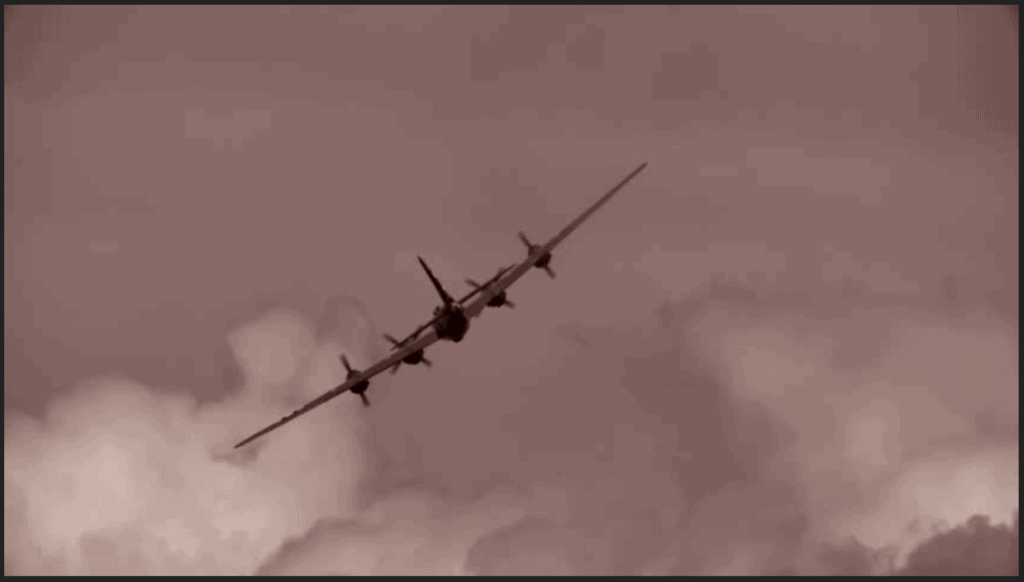
On August 6, 1945, seventy-six years ago today, an American propeller-driven bomber plane called the Enola Gay dropped a nuclear warhead over Hiroshima, Japan. Upon impact, the bomb instantly destroyed a city and approximately 80,000 civilians. Three days later, another nuclear bomb devastated the city of Nagasaki, wiping out another 40,000 lives. It’s no hyperbole to call these bombings apocalyptic.
Japan surrendered to the Americans, spelling the end of World War II. But the death toll continued to rise in the following weeks and months with the aftereffects of burns, injuries, radiation sickness. In the following years, cancer and leukemia and other diseases attributable to radiation continued to take lives of those who had been in the blast zones. In total, the deaths of more than 230,000 people can be attributed to these two bombings. In addition, countless citizens who survived with no apparent physical symptoms suffered PTSD. The sight of any bomber plane could undoubtedly trigger symptoms in any survivor from Hiroshima or Nagasaki.
Wars still happen. And we still fly warplanes over cities even during peaceful times.
Last month, on the afternoon of Saturday July 17, I was in my front garden in North Saanich, British Columbia, with my partner and a close friend, when we heard a jet. We live near Victoria International Airport (YYJ) so we’re accustomed to hearing takeoffs and landings when the wind’s blowing our way. But this was no routine jet engine sound. The volume increased suddenly and rapidly, and we looked up to see a fighter jet right over our house, disappearing into the trees, followed by a roar that caused us all to cover our ears. In seconds, it was over, and I stood there, stunned. But less than half a minute later, the noise returned as the plane circled back, and I thought to myself, “There’s going to be a crash.” This was no logical thought; my instinct was to run and seek shelter, but I was frozen and couldn’t move. Animal reflexes would not have saved me, had this been war. And then, as quickly as it had come, it was gone, and I could hear the birds singing. But I was shaken. Literally.
I live with PTSD. I didn’t get it from a plane crash or seeing my city or my family being bombed. But the deafening roar and the sight of a warplane triggered my nervous system into freezing, crying and shaking. Our friend, who’s from the Middle East, and frequently tells us how safe he feels in Canada, was also left feeling uneasy.
Afterwards, we all chalked it up to random military practice. But the next day I was out on a hike and heard another roar. I froze in my tracks once more, but this time I was lucky enough to not be under the flight path. Later at home I did a quick internet search and learned about Operation Inspiration, including the planned flyover of an entire CF-18 fighter jet team the following day, July 19. This campaign, begun by the Snowbirds (Canada’s air force demonstration team) last year in the first months of the COVID-19 pandemic, is meant to honour the front-line workers and to uplift Canadians everywhere. I couldn’t make the connection. Needless noise pollution, gratuitous carbon emissions, and taxpayer dollars to fly planes so that we can all feel better. It made even less sense when I learned that, ironically, on May 17th of last year, only a few weeks into this campaign, one of team’s planes went down moments after takeoff, and crashed in the middle of a residential neighbourhood in Kamloops, BC, killing Captain Jennifer Casey and injuring pilot Captain Richard MacDougall, who landed on the roof of someone’s home. Suddenly it didn’t seem so far-fetched that I feared a plane crashing onto my house.
Now I assumed that the fighter jet I witnessed on July 17 was on a practice flight for Operation Inspiration. More searching turned up no such details, even on government web pages, and YYJ couldn’t help me. Finally, I got in touch with a spokesperson with the CF-18 Demo Team, who informed me that on July 17 the aircraft in question had been on an ordinary training flight to Victoria International Airport from Cold Lake, Alberta, at least a thousand kilometres by air. Unconnected to Operation Inspiration, but it certainly drew my attention to the event.
As a pacifist, I don’t support the military, although I have friends in the forces and I understand and respect their beliefs around keeping peace. So I am somewhat conflicted. But what I’m not conflicted about is the appropriateness of Operation Inspiration. I understand that some people are awed, entertained, and even moved by the sight of jets manoeuvring deftly, flying in tight formation, something that takes a lot of skill. But, the flight path on these aerial shows flights is over HOSPITALS, and that included over half a dozen local hospitals on the Saanich Peninsula, in Victoria, and farther north up Vancouver Island. It’s a misguided gesture, I believe, to honour anyone by flying loud military aircraft over buildings where people are supposed to be healing from physical, emotional, and mental trauma. I shake my head at the irony. Trauma is at the heart of so many issues that concern us right now, individually and as a nation, so it’s time for our military to reassess their policies, at the very least the ones that involve citizen outreach, like Operation Inspiration.
I have nothing against the individuals who work to keep us safe. But there’s something wrong if displays of military might are entertaining to us, and if we think they’re an appropriate or relevant way of thanking other people for doing their part to keep us safe. It’s disrespectful, wasteful, insensitive, and I struggle to find the inspiration in it.
Peace and hope for 2021
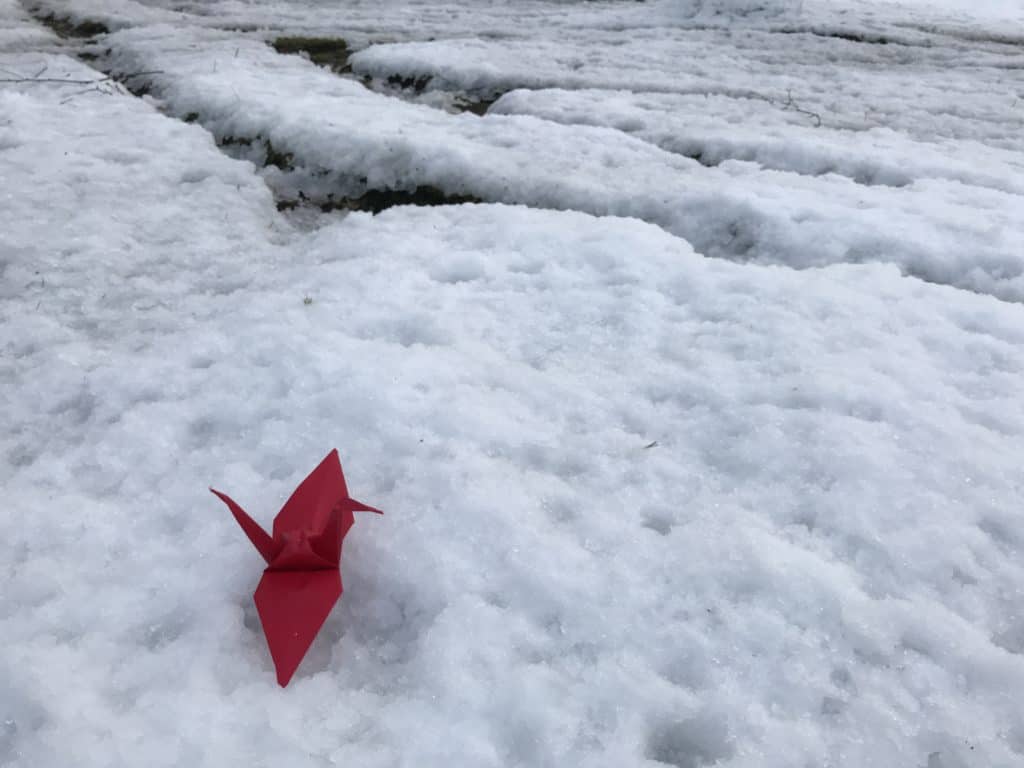
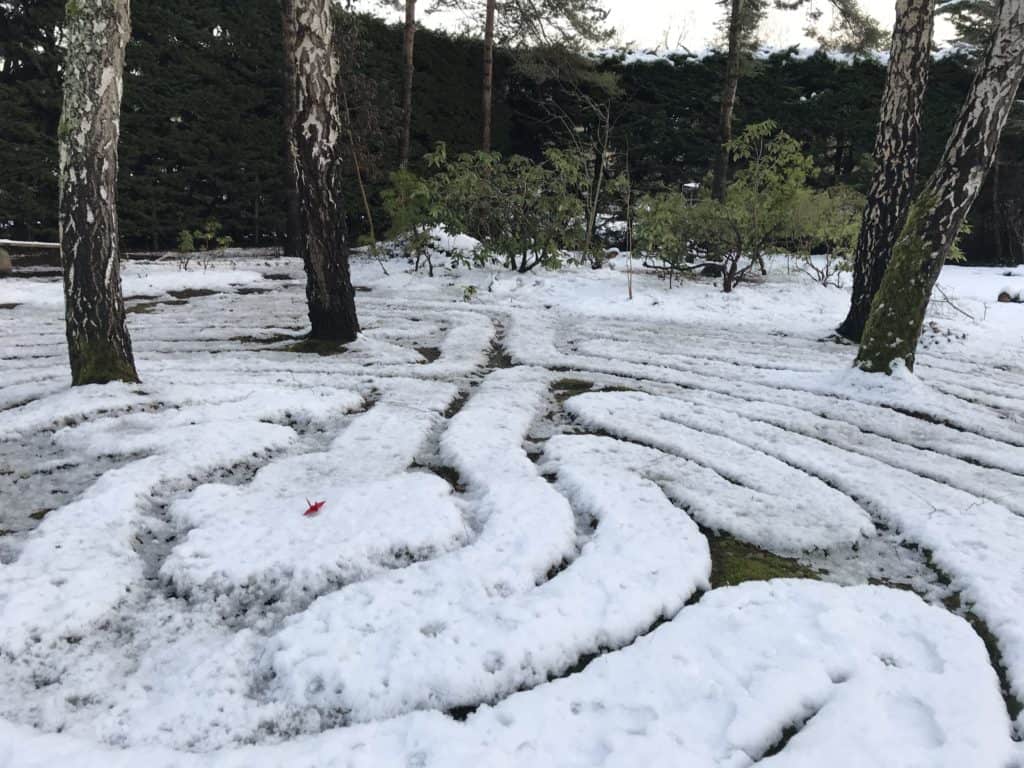
May we find our way home this coming year.
UN International Day of Peace, 2020
Today is another reminder of the importance of peace. During these times, we all know someone (or know someone that knows someone) who has lost a family member, lost a job, lost a home, lost faith, lost sanity…. And as we are having to face our worst nightmares (not just Covid, but wildfires, political upheaval, and other tragedies and atrocities) we are being divided, asked or ordered to physically distance ourselves from each other. I believe that what we actually need right now is uniting, but we can’t even disagree politely about how to act in the face of this pandemic. Let’s remember that although this virus is bringing out the worst of our fears, greed, apathy, and loneliness, stretching our limits of patience and tolerance and trust, it can also bring out the best in us—our altruism and ingenuity, as we find ways to serve each other’s needs, and connect “safely”. We need each other. PEACE is about admitting our vulnerability, being willing to let go of our fear, and coming back into healthy relationship with each other and ourselves, even if all we can do right now is agree that we need to change. It’s a start.

Hiroshima 75
Fifteen years ago this day Derek Youngs and I visited Hiroshima, on August 6th 2005, to commemorate the 60th anniversary of the nuclear bombing of Hiroshima. We sat in the morning sun, amidst a sea of other attendees, listening to the dignitaries, the children’s choir, the survivors, and the cicadas. A A small gold paper peace crane sat in Derek’s lap. A large insect, like a grasshopper or mantis, landed on his knee, right next to the gold bird and stayed there for many minutes, seeming to examine the origami bird with great curiosity, from all angles. It was hot that day, over 40 degrees and high humidity, and we were drenched in sweat. I did not let myself succumb to the discomfort, as all I could think about was the fire that raged that day 60 years earlier, the flames even sweeping down the river. I realized that beneath our feet in the Peace Park (the epicentre of the nuclear bomb blast) probably lay the remains of thousands of people. It was hard to fathom. How could we have let that happen? How did we let fear and hate take us so far?
Derek’s many miles and years of walking didn’t put an end to war—the 75th anniversary of Hiroshima and Nagasaki just passed and nuclear weapons still exist. Derek’s wish was heartfelt, and perhaps naïve, but I know that every step he took was not in vain. I believe the human race does care about the survivial of our species, and all the survival of all other living things on Earth. And I believe that if we keep walking, one step at a time; keep making peace cranes, one fold at a time; keep tending our gardens, one leaf at a time; and keep working through our differences, one word or one small gesture at a time; we will triumph. Love conquers all.
I walked in the peace labyrinth today, thinking of love and light, remembering Hiroshima, Derek, and the grasshopper.
JOY to the world!

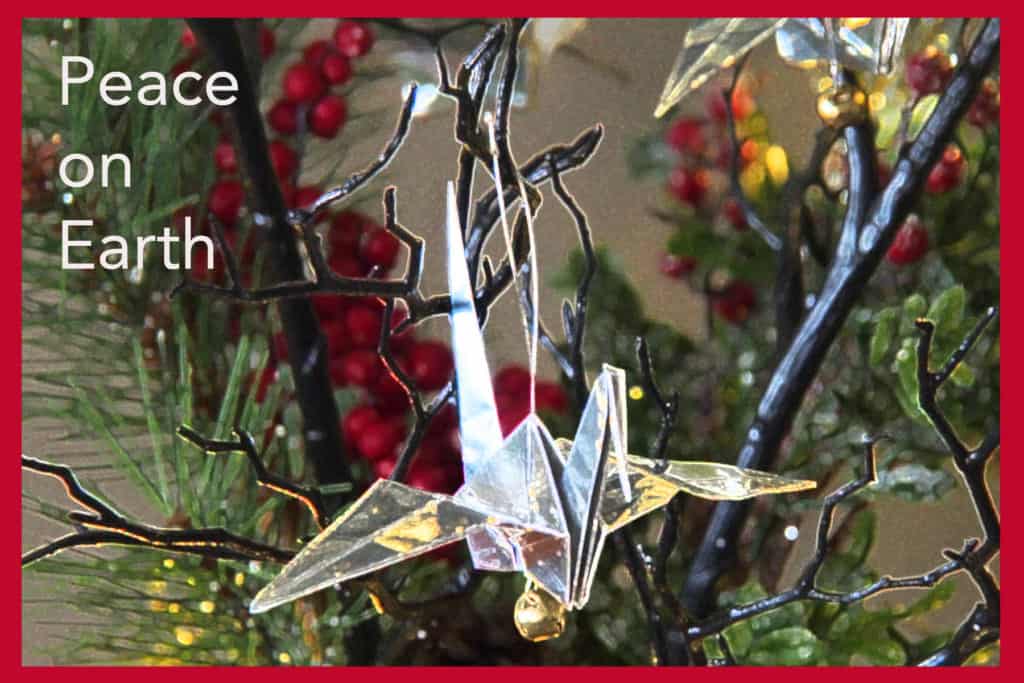
This holiday season has been one of the most peaceful, paradoxically, as I get ready to move house. I took this photo when packing up Christmas ornaments, and that’s as close as they got to seeing the light of day this year.
Normally, I love getting caught up in all the seasonal excitement, but with books to sell and choir concerts to get ready for, in addition to the usual decorating and wrapping and baking, I can feel stressed. I know I’m not alone in feeling overwhelmed. So, this year, anticipating the extra workload with all the packing and paperwork, I decided to let go of my Christmas routine — except the music. Music takes me to that peaceful yet energized place within myself, a state that I’ve always had access to, beyond the noise and hustle-bustle, the materialism, the worries stirred up by world news.
Every day holds promise, but this season of Winter Solstice and Christmas, and the new year around the corner, we’re reminded more often. We don’t have to buy hope and happiness; it’s inside all of us, part of our very DNA. My wish is that we can all experience our own transcendent state, in whatever way each of us does, more and more, until it spills out and ripples into each other’s lives. JOY to the world!
xoxo
Carolyn
Something different this Remembrance Day
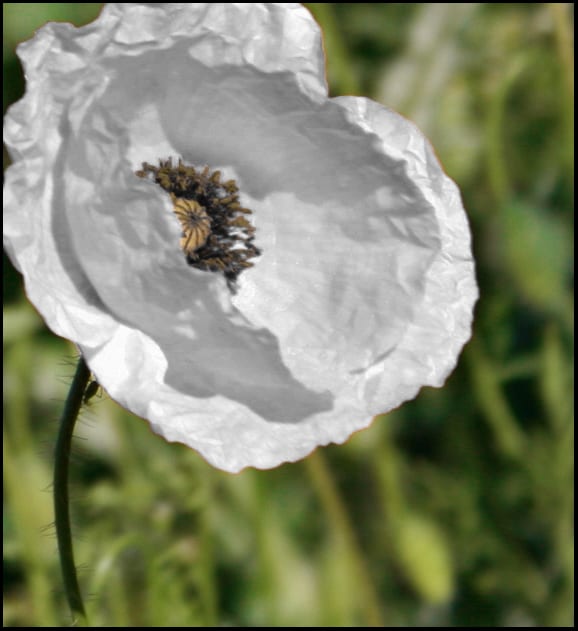
Remembrance Day is upon us, and I am wearing a white poppy.
This alternative to the red poppy was designed by a group of British women in 1933 to reaffirm their commitment to peace. I see it as a focus away from the red of bloodshed towards the light of hope — a hope that comes from love.
We are all familiar with the red poppy that marks Remembrance Day (also known as Armistice Day and Veterans’s Day.) The symbol commemorates all those who have died serving in armed conflict, and its message is “Never Again”. But wars are still happening.
We are forgetting the reason to remember, the reason to spend time in silence. Instead, in some places the day is capitalized on by retailers as an excuse to offer discount sales. More gravely, if we zoom out to the bigger picture, we see a military industrial complex with deep ties to our economy. It seems there is much to lose if we stop manufacturing instruments of war, and if we stop invading countries to plunder resources. But this is fear talking.
Critics say that to refuse the red poppy is to disrespect those who have fought for our country. I disagree. I honour all those who have died as the result of wars, innocent civilians and military personnel. War is not necessary, and I refuse to normalize it. There is another way. If I choose to love you and not fear you, I will not harm you, and I will not seek power over you. This may not be easy, but it is simple, and it can start right now.
An anniversary
Today would be our 9th wedding anniversary, and the 15th anniversary of our journey as friends. Derek and I are still on that journey, but it’s a very different experience being in relationship with someone who doesn’t exist in the material world anymore. I still miss his physical presence. His was a very grounded, solid physicality. When he was with me, his attention made me feel like a star.
We walked into each other’s life in 2004, on the Camino pilgrimage in Spain, when I was working through the grief of my father’s death. I helped walk him through the grief of his wife’s death three years later. The steps we took together were literal and figurative, but it’s so meaningful for me to remember those physical ones.
On one occasion in a small European town, I remember tripping and stumbling on cobblestones, and his reaching out to catch me before I hit the ground. “Are you falling for me?” he quipped, a twinkle in his eye. Often, while trekking on the Camino, suddenly his imagine would pop into my brain, and then there he was. He always showed up at the right time, somehow magically knowing when and where to find me. I never had to wait and wonder. One year — it could have been 2008 or 2009, I walked all the way from Langdale to Lund on the Sunshine Coast, north of Vancouver. It took the better part of a week walking mostly on the highway for four to six hours a day, and Derek would meet me at the end of each stage, a huge grin on his face and admiration in his eyes. He loved nothing better than to support me (and I him). Today I drove part of the way along the same highway and the feeling came back to me instantly, this warm knowing, that after so many hours passing trees and lakes and hills, I would round a corner and he would be there just when I was flagging.
My destination today was Skookumchuck Narrows, the sea rapids where Sechelt and Jervis Inlets meet. The first time I made the hike there was with Derek. After getting out of the car, he held my hand that whole hour while I walked with my eyes closed. He had me reach out and feel different textures — dry tree bark, moist spongy moss. He had me stop and smell resinous pine needles and earthy mushrooms. We agreed that the forest smelled its own shade of green, like no other. He had me step up onto stumps and jump down. He had me listen to the different qualities of sound, surrounded by thick forest compared to a clearing beside a pond. How near to the rapids did we get before I could hear them? How giddy I became when I heard their faint roar in the distance.
When we finally made it to the rocky outlook the sound engulfed me. The intensity of the water was palpable. I opened my eyes and tears of joy began to flow. How glorious the colours — the amazing array of grey granite hues under my feet, the deep blue of sky above, and the white foam of racing water. I laughed and laughed in pleasure and awe. Today I stood there just like the first time, mesmerized by the coursing, surging tide. I thought back to that first time, and how little we had to say to one another in that moment, so full of gratitude and love. A moment later I was snapped back to the present — a black shape surfaced, and then disappeared. What had I just seen? I kept my eyes fixed on the eddies and began to get dizzy. A minute later, another shape emerged, ever so briefly breaking the waves before disappearing in the swirl. A dolphin! I watched for some minutes. It seemed to be at play but perhaps there were tasty fish below the froth. What strength it would take to keep from being swept out with the tide.
Eventually I headed back along the trail. Today Derek wasn’t there to hold my hand physically and guide me, but I felt him walking with me. I closed my eyes and felt my centre of gravity drop. I walked for half a minute along the rocky trail, lifting my feet high and noticing the shifting of my weight. It felt effortless. I had the urge to take long slow inhalations. It smelled like green. I laughed.
Joy and blessings to all…
…and love to friends and family at home and far afield, and to those who are lonely, hungry, grieving or in pain. May we give all we can and receive all we need.
May all our wishes for peace come true.
Want to know when a new post is published?
Send us your email address and you will automatically be notified.